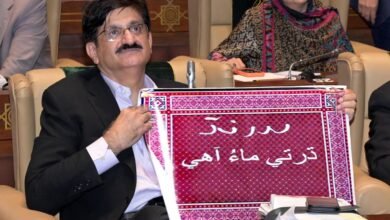
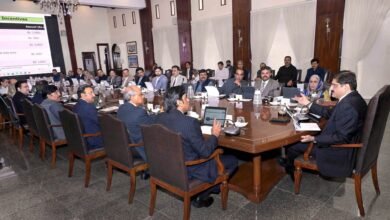
The Sindh Assembly on Monday approved the provincial budget for the fiscal year 2025-26, presented by Chief Minister Syed Murad Ali Shah, with a total outlay of Rs3,450 billion which marks a 12.9 per cent increase compared to the previous financial year.
The removal or withdrawal of six levies, especially the Professional Tax, will benefit the people, with the latter providing a Rs5 billion relief. The budget emphasises social protection, infrastructure development, economic reforms, and comprehensive relief measures for the underprivileged.
The assembly members discussed expenditures charged to the provincial consolidation fund and reviewed and voted on demands for grants on supplementary statements for the year 2024-25.
There were a total of 188 demands, against which the opposition moved 2002 cut motions, which were rejected by a majority vote; most of the cut motions were grouped together and rejected. The assembly passed demands for grants for the year 2025-26 after discussion and voting.
Finance Bill 2025: Sindh Chief Minister Syed Murad Ali Shah presented the Sindh Finance Bill in the house to rationalise levies and certain taxes and duties and to amend relevant laws.
Reform Measures: The government is introducing blockchain-based land record digitisation, online mobile-based birth registrations, and credit access for farmers via the Sindh Cooperative Bank. A one-step land ownership transfer system is also being launched.
Relief for Employees: The budget provides Rs43 billion for a new Ad-hoc Relief Allowance and Rs16 billion for a 15 per cent increase in pensions.
Tax reliefs include:
Professional Tax: The chief minister announced to removal six levies from the upcoming financial year 2025-26. They include:
Professional Tax: The Professional Tax, which affects salaried people and small businesses, has been withdrawn. This alone is a Rs5 billion relief to the salaried people and businessmen, particularly the small ones.
Entertainment Duty: The Entertainment Duty, which will help encourage cultural and entertainment activities across the province, has also been withdrawn/removed.
• 50per cent reduction in fees for mutation, sales certificates, certified copies, solvency and heirship certificates.
• Yearly commercial vehicle tax capped at Rs1,000.
• Rationalisation of entertainment duty, drainage cess, and cotton fee.
Grants and Social Sector Allocations: Significant grants have been earmarked for critical institutions:
• Rs42.2 billion for public universities
• Rs 10.4 billion for medical education
• Rs5 billion for an Inclusive City for PWDs
• Rs6.6 billion for the Sindh Institute of Child Health and Neonatology
• Rs5.2 billion for ambulance services under SIEHS
The chief minister, who also holds the finance portfolio, highlighted key macroeconomic indicators while unveiling the budget. Pakistan’s national GDP growth target for 2025-26 has been set at 4.2pc, up from the actual 2.68% recorded in 2024-25. Inflation is targeted at 7.5pc, compared to 4.7pc this year. The Federal Board of Revenue’s (FBR) target for 2025-26 has been set at Rs14,131 billion.
Expenditure Breakdown: The total expenditure includes Rs 2,150 billion under Current Revenue Expenditure (CRE), constituting 62pc of the total outlay. This covers salaries, pensions, grants, operations, and maintenance. Development expenditure, which accounts for 30pc of the budget, stands at Rs1,018.3 billion and includes the Annual Development Programme (ADP), foreign-assisted projects, and district development allocations. Capital expenditure amounts to Rs281.7 billion, covering loan repayments, viability gap funding, and investments.
Within the CRE, 39 pc is earmarked for salaries, 29 pc for grants (including local bodies and autonomous institutions), 19 pc for non-salary operating costs and maintenance, and 13 pc for pensions.
Revenue Projections: Despite previous fiscal challenges and revenue shortfalls, with a -3.6 pc shortfall against budgeted estimates in FY 2024-25, the provincial government expects a significant recovery. For FY 2025-26, total receipts are projected at Rs3,111.5 billion, marking a 21.4pc increase from the revised estimate of Rs2,562.7 billion. Over the next three years, Sindh anticipates an annual average revenue growth rate of 12.5pc.
If the FBR achieves its revised target of Rs11.7 trillion by June 2025, Sindh expects a share of around Rs269 billion in the federal divisible pool taxes.
Development Initiatives: The provincial ADP is a key highlight within the Rs1.018 trillion development spending. Major development themes include:
• Agriculture & Rural Support: Rs8 billion allocated for the Benazir Hari Card scheme and Rs1.8 billion for livestock breeding.
• Farm Mechanisation: Introduction of solar tubewells, drip irrigation systems, and super seeders at subsidised rates.
• Housing for the Poor: Rs2 billion allocated for low-income housing initiatives.
• Social Welfare: Rs2 billion for the Sindh People’s Support Programme and Rs200 million for orphan and widow support.
• Women Empowerment: Rs500 million for women agriculture workers and Rs500 million for SME development.
• Health Sector Expansion: Full-fledged SIUT centre at Larkana (Rs4.5 billion), Rs21 billion for SIUT, Rs23 billion for NICVD, Rs16.5 billion for PPHI, and Rs10 billion for a new hospital in Larkana.
• Education & Special Needs: School-specific budgets, expanded stipends for Persons with Disabilities (PWDs), and the doubling of assistive devices from 20,000 to 40,000.
• Youth Development: Operationalisation of 27 Youth Development Centres (YDCs) across the province.
• Water Infrastructure: Rs 10 billion for Dumlottee-DHA water pipeline and Rs 3.1 billion for Hub Canal.
• Renewable Energy: Rs25 billion block allocation for green energy and Rs45 billion for SDG-linked public health initiatives.
Reform Measures: The government is introducing blockchain-based land record digitisation, online mobile-based birth registrations, and credit access for farmers via the Sindh Cooperative Bank. A one-step land ownership transfer system is also being launched.
Relief for Employees: The budget provides Rs43 billion for a new Ad-hoc Relief Allowance and Rs16 billion for a 15 per cent increase in pensions.
Tax reliefs include:
Professional Tax: The chief minister announced to remove six levies from the upcoming financial year 2025-26. They include:
Professional Tax: The Professional Tax, which affects salaried people and small businesses, has been withdrawn. This alone is a Rs5 billion relief to the salaried people and businessmen, particularly the small ones.
Entertainment Duty: The Entertainment Duty, which will help encourage cultural and entertainment activities across the province has also been withdrawn/removed.
• 50per cent reduction in fees for mutation, sales certificates, certified copies, solvency and heirship certificates.
• Yearly commercial vehicle tax capped at Rs1,000.
• Rationalisation of entertainment duty, drainage cess, and cotton fee.
Grants and Social Sector Allocations: Significant grants have been earmarked for critical institutions:
• Rs42.2 billion for public universities
• Rs 10.4 billion for medical education
• Rs5 billion for an Inclusive City for PWDs
• Rs6.6 billion for the Sindh Institute of Child Health and Neonatology
• Rs5.2 billion for ambulance services under SIEHS
Murad Ali Shah called the budget a “responsible, inclusive, and forward-looking fiscal plan” focused on inclusive growth, equity, and efficiency. “This budget is a response to the economic hardship people have faced, and a roadmap to rebuild Sindh with resilience, opportunity, and social justice,” he concluded.