Lahore witnessed a sharp deterioration in air quality on Monday, with the Air Quality Index (AQI) crossing the hazardous 500 mark in the morning, as concerns over Diwali fireworks, crop-residue burning in Indian Punjab and easterly winds carrying transboundary pollution came into focus. However, an intensive, multi-pronged response by the Punjab Environment Protection and Climate Change Department (EPCCD), including anti-smog gun operations, stubble-burning enforcement and industrial inspections, brought a substantial improvement in the city’s air quality by afternoon.The Punjab government’s special assessment issued on November 8 had already warned of a possible increase in pollution levels across Lahore, Kasur and adjoining border districts on November 9. The report identified Diwali fireworks, agricultural residue burning across the border, easterly winds and stagnant atmospheric conditions as potential contributors to the deteriorating air quality.According to the assessment, smoke generated by Diwali fireworks could reach Lahore within five to thirteen hours, depending on prevailing wind conditions. With Amritsar located approximately 50 kilometres from Lahore, the movement of polluted air across the international border remained a significant concern.The report also highlighted 2,347 incidents of crop-residue burning in Indian Punjab up to November 4. Of these, 1,081 incidents were recorded in Tarn Taran, Ferozepur and Amritsar districts, accounting for approximately 46 per cent of the reported incidents in Indian Punjab. Their geographical proximity to Lahore and Kasur raised concerns about the potential movement of smoke and fine particulate matter into Pakistani territory.The assessment further noted that particulate pollution in Lahore had already reached 202 micrograms per cubic metre during nighttime hours before Diwali, indicating that the city was experiencing considerable pollution pressure even before the festival-related emissions.The Punjab government had forecast elevated pollution levels for November 9 and 10, with a possible marginal improvement from November 11. Indian media reports also highlighted worsening air quality following Diwali celebrations in Amritsar, Ludhiana, Jalandhar and Patiala, while Mandi Gobindgarh recorded an AQI of 445. New Delhi also experienced a significant deterioration in air quality following widespread fireworks.Against this backdrop, the Environment Protection and Climate Change Department intensified its emergency response across Lahore and other vulnerable areas of Punjab. Multiple anti-smog guns were deployed at high-traffic corridors, 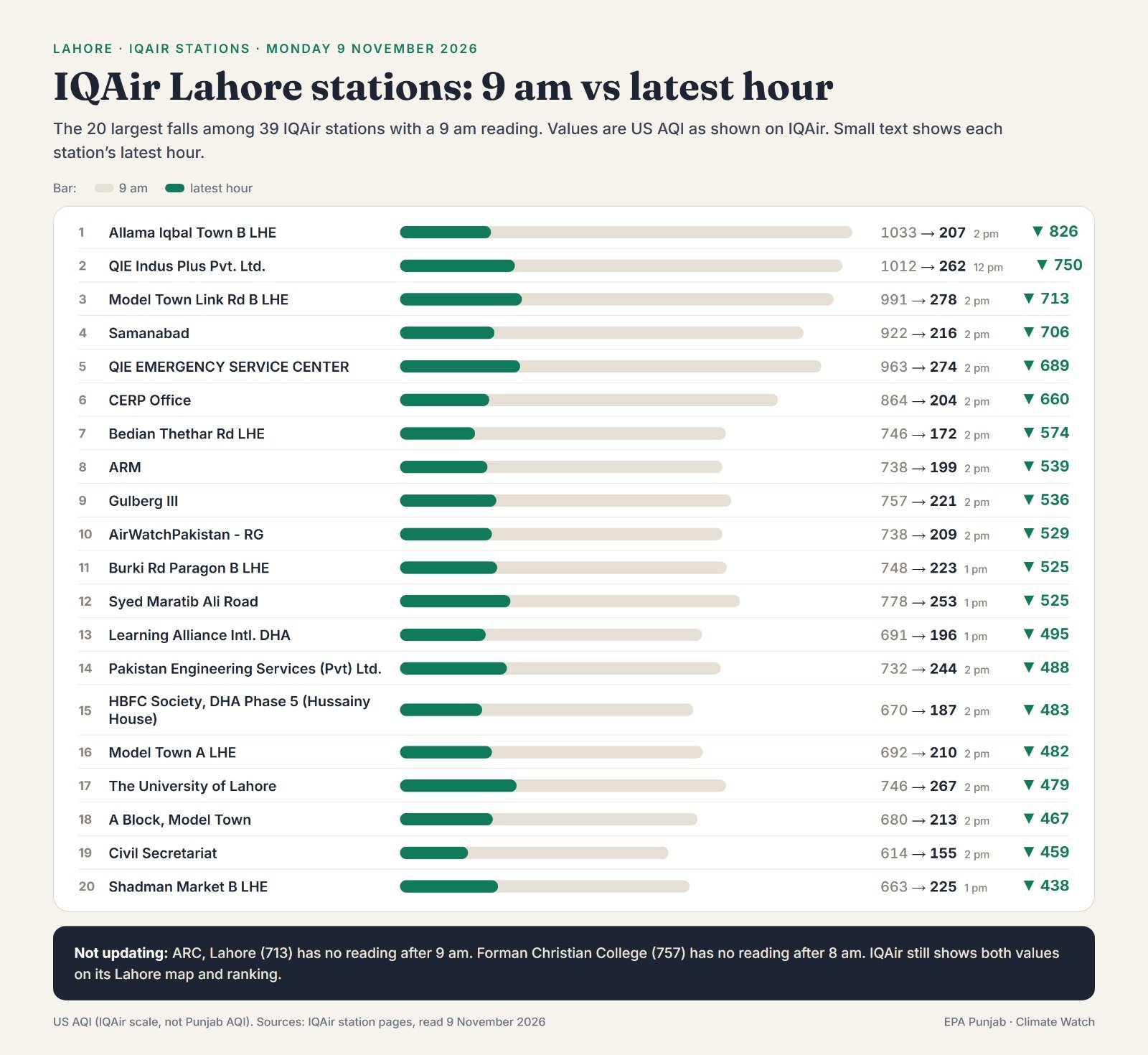
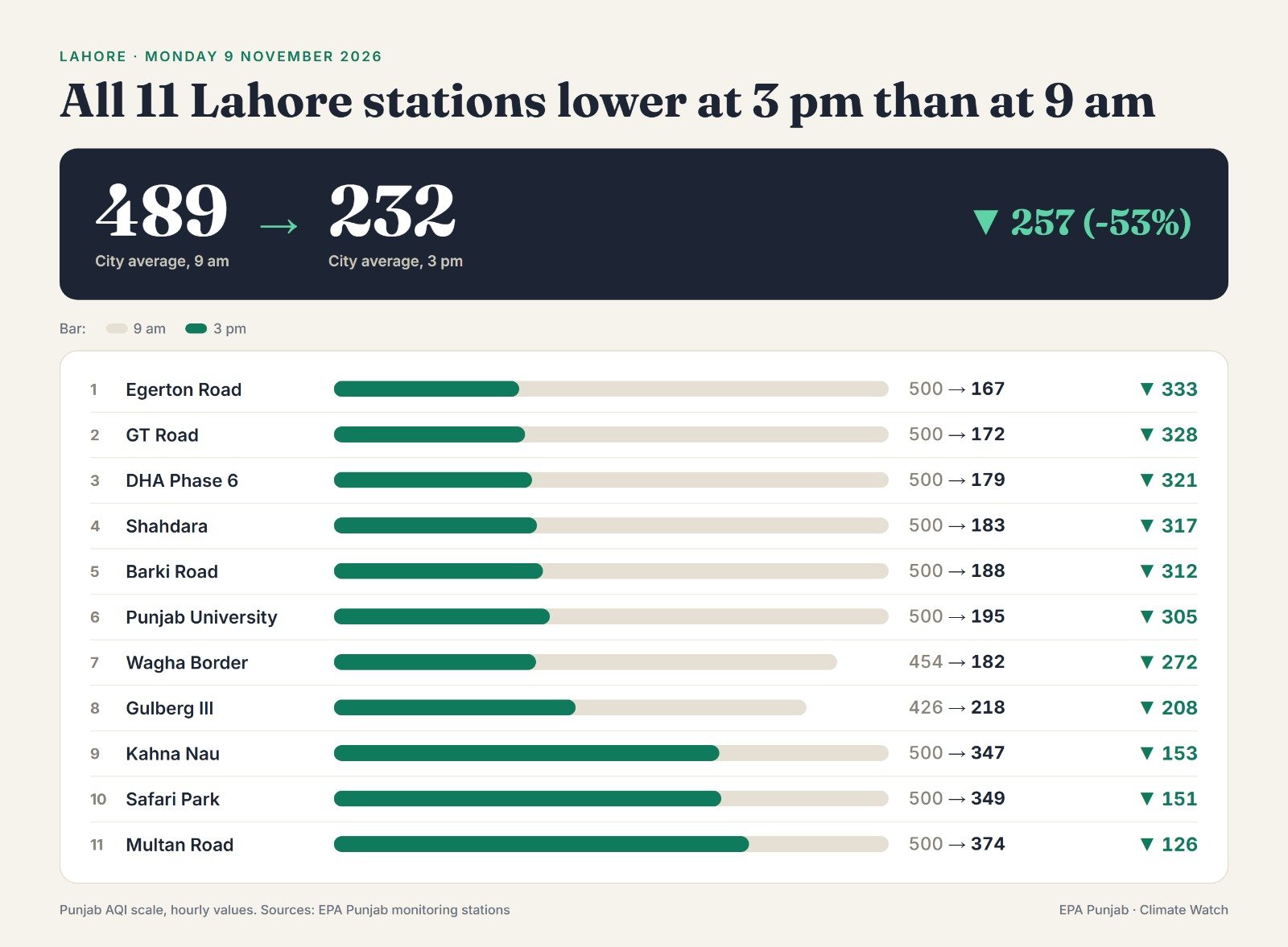
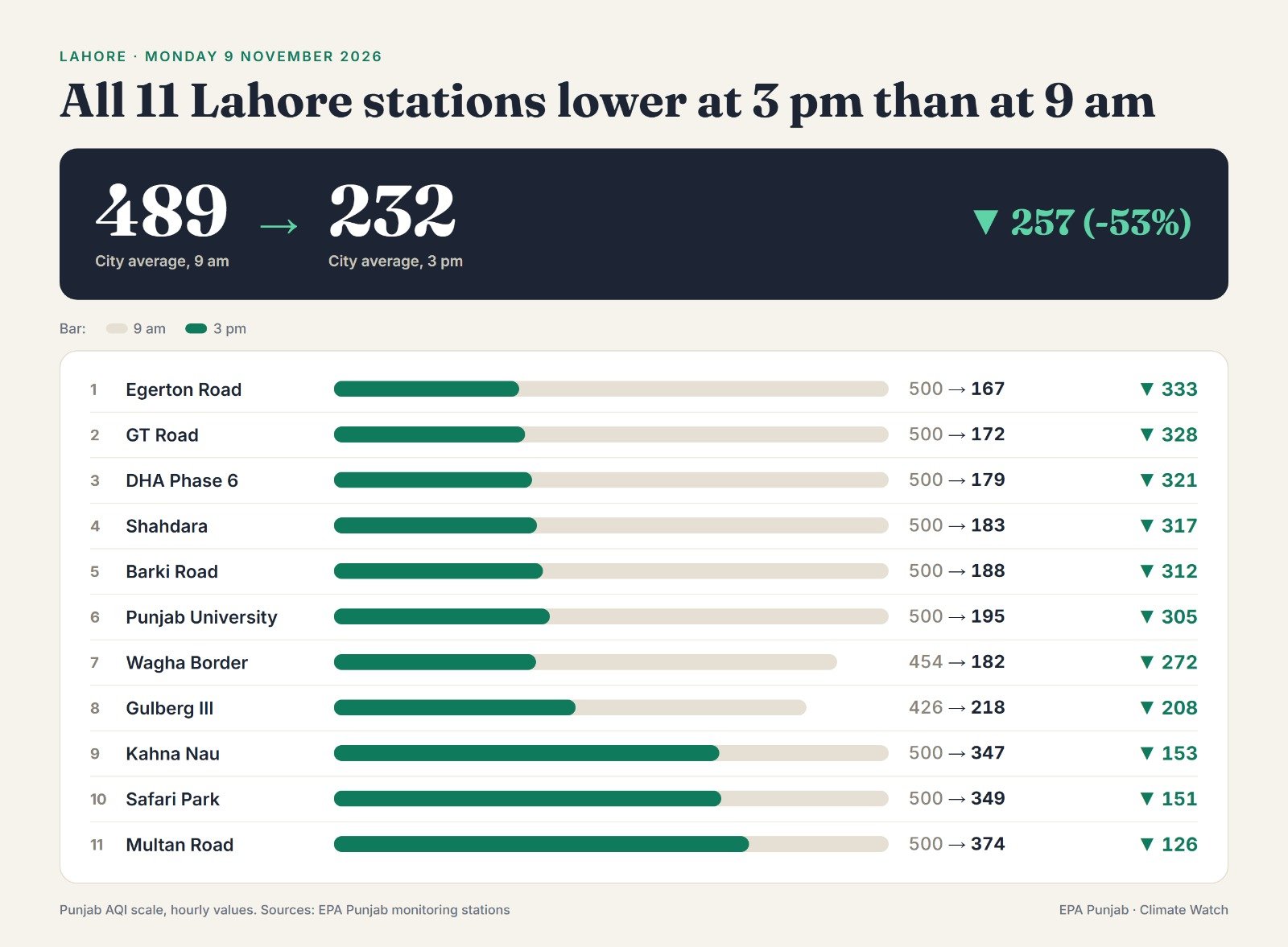 dust-prone locations and pollution hotspots, with mist-sprinkling operations covering approximately 640 kilometres of operational routes.The impact of the intervention was reflected in the department’s monitoring network. Data from all 11 Lahore monitoring stations showed a decline in pollution levels between 9am and 3pm on Monday. The city’s average AQI, recorded at 489 in the morning, fell to 232 by 3pm, representing a reduction of 257 points, or approximately 53 per cent.Egerton Road recorded the most significant improvement, with its AQI declining from 500 to 167, followed by GT Road, where the reading fell from 500 to 172. DHA Phase 6, Shahdara, Barki Road and Punjab University also registered substantial reductions. Improvements were recorded at Wagah Border, Gulberg III, Kahna Nau, Safari Park and Multan Road as well.Secretary EPCCD Silwat Saeed said the department was responding to the deteriorating air quality through coordinated enforcement, real-time environmental monitoring and targeted field interventions. She emphasised that transboundary pollution and weather patterns required a comprehensive response alongside strict action against domestic sources of emissions.She said the department was utilising its monitoring infrastructure and Punjab Climate Watch data to identify pollution hotspots and guide operational teams towards areas requiring immediate intervention. The focus, she added, remained on ensuring that enforcement against local pollution sources continued without interruption, even when regional weather conditions intensified the smog situation.Director General Environment Abdullah Nayyar Sheikh said the department had adopted a zero-tolerance approach towards all major sources of air pollution and was operating multiple enforcement mechanisms simultaneously.He said Quick Response Units (QRUs) were actively responding to satellite-detected fire anomalies and reports of agricultural residue burning, with field teams being dispatched to affected locations to extinguish fires and take action against those responsible. Punjab Climate Watch’s satellite-based monitoring and continuous surveillance were helping authorities identify fire incidents, particularly during nighttime hours, when agricultural burning often went undetected through conventional monitoring.The DG said enforcement against industrial pollution had also been intensified, with inspection teams monitoring factories, brick kilns and other emission-generating units to ensure compliance with environmental standards. Industries operating without appropriate emission-control systems were being proceeded against under environmental regulations, while non-compliant brick kilns and units involved in illegal activities faced sealing, demolition and legal action, where warranted.He added that anti-smog gun operations had been expanded to their maximum operational capacity in Lahore, with multiple machines covering approximately 640 kilometres of designated routes. The mist-sprinkling operations were being directed towards high-dust and high-traffic locations, while monitoring data was being used to identify priority areas and assess changes in air quality.Abdullah Nayyar Sheikh said the reduction recorded at all 11 monitoring stations was an encouraging development, but the department would not interpret a temporary improvement as the end of the smog challenge. Enforcement, surveillance and mist-sprinkling operations would continue alongside action against industrial emissions, agricultural fires and other local pollution sources.Officials, however, maintained that determining the precise contribution of Diwali fireworks, crop-residue burning and other transboundary sources to Lahore’s pollution levels required detailed scientific analysis of air-quality measurements, wind patterns and particulate composition. The department planned to release comparative findings on November 10 to provide a clearer assessment of the cross-border impact.The latest developments have once again highlighted the regional dimension of Lahore’s smog crisis, while the improvement recorded on Monday afternoon underlined the importance of coordinated monitoring, rapid enforcement and sustained mitigation measures in managing the city’s deteriorating air quality.
Diwali Fireworks, Cross-Border Smoke Raise Alarm as Lahore Battles Hazardous Air Pollution