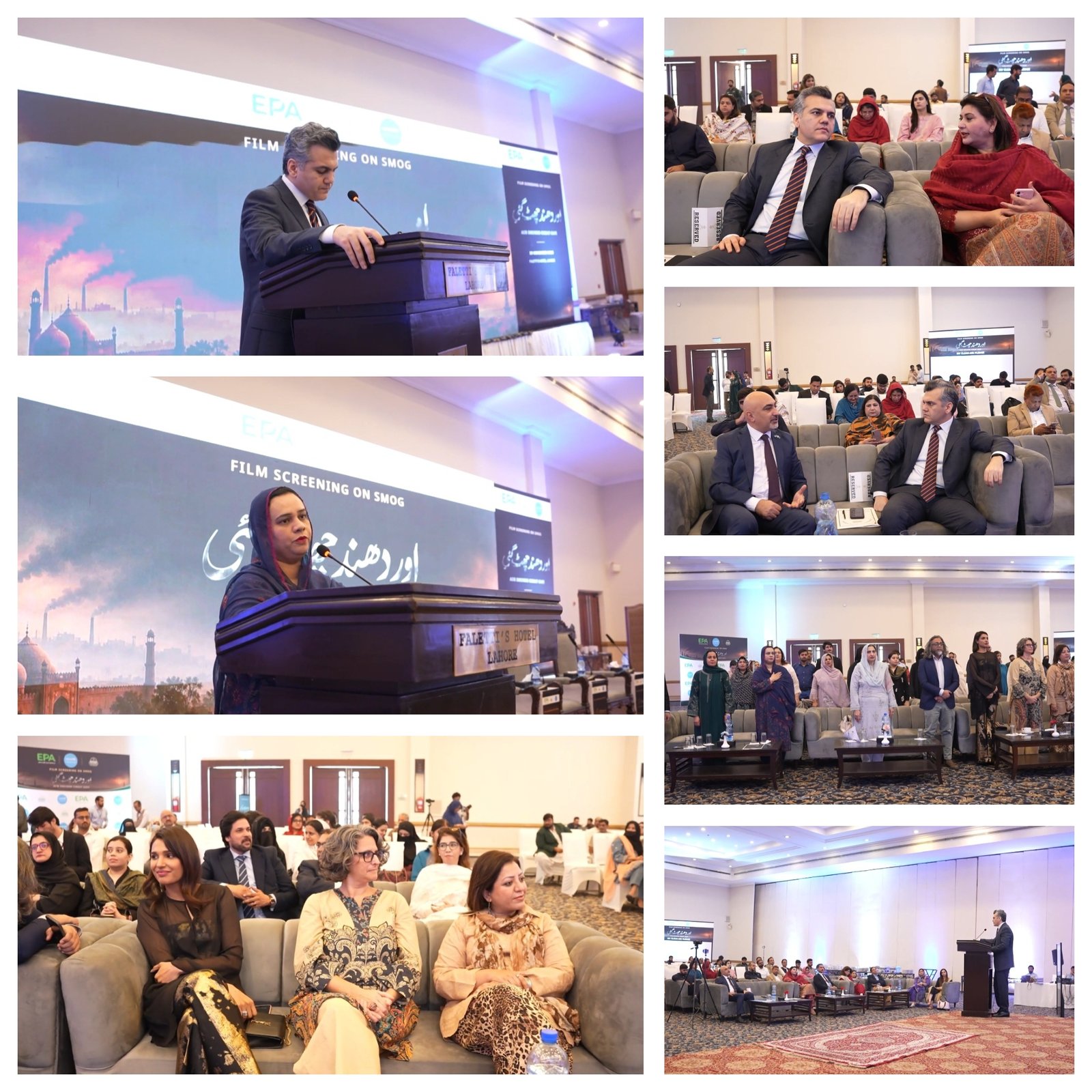
A documentary titled “Aur Dhund Chhat Gayi” (And the Haze Disappeared), highlighting Punjab’s efforts to combat smog and improve air quality in Lahore, was screened at the Faletti’s Hotel on Thursday, bringing together senior environmental officials and policymakers to showcase the province’s ongoing initiatives to address air pollution and protect public health.Director General of the Environmental Protection Agency (EPA) Punjab Abdullah Nayyer Sheikh and the Parliamentary Secretary for Environmental Protection attended the screening as guests. The documentary highlights measures taken to tackle smog in Lahore and their long-term implications for the health and environment of future generations.The film has been produced through a collaboration between EPA Punjab and the Planning and Development Board, with technical support from UNICEF. Its central message is that the fight against smog must go beyond seasonal interventions and remain a sustained effort to ensure a cleaner, healthier and safer environment for coming generations.Speaking on the occasion, DG EPA Punjab Abdullah Nayyer Sheikh said the provincial government was committed to continuing anti-smog measures throughout the year rather than restricting enforcement and mitigation activities to the winter season. He said air pollution was a long-term challenge that required continuous monitoring, effective enforcement, technological interventions and public participation.He said Punjab had expanded its air-quality monitoring network to 81 stations to strengthen the collection of real-time environmental data and improve the assessment of pollution levels across the province. The number of air-quality monitoring stations was expected to exceed 100 by the beginning of next year, he added.According to the DG, the expansion of the monitoring network would help authorities identify pollution trends, assess the impact of interventions and take timely measures in areas experiencing deteriorating air quality. He said reliable monitoring and data-driven policymaking were essential for addressing the sources of pollution and evaluating the effectiveness of government interventions.Mr Sheikh said the EPA had also strengthened its enforcement capacity by deploying an Environment Protection Force comprising 700 personnel to ensure implementation of environmental laws and regulations. During the past year, the agency had carried out around 5,400 enforcement actions against environmental violations, while approximately 4,500 FIRs had been registered against those found violating environmental laws.He said enforcement operations were being complemented by structural measures aimed at reducing emissions from industrial and commercial sources. More than 8,000 brick kilns across Punjab had been converted to zigzag technology, which helps improve combustion efficiency and reduce smoke emissions compared with conventional brick-making methods.Similarly, pollution-control systems had been installed in 91 per cent of industrial units across the province, he said, adding that the installation and effective operation of such systems were important components of the government’s strategy to reduce industrial emissions.The DG said construction-related dust was another major contributor to urban air pollution, particularly in densely populated areas. Special standard operating procedures had been introduced for construction sites to control dust emissions and ensure that development activities did not unnecessarily add to the pollution burden.He said the government was also addressing agricultural sources of air pollution, particularly the burning of crop residue, which contributes to smog during the winter months. More than 10,000 super seeders had been provided to farmers to encourage the management of crop residue without burning it in fields.In addition, 1,300 farmer groups had been provided with harvesters and balers to promote the use of modern agricultural machinery and facilitate the collection and management of crop residue. These interventions were intended to provide farmers with practical alternatives to the traditional practice of burning leftover straw after harvesting.Highlighting the impact of these initiatives, Mr Sheikh said crop-residue burning incidents had declined by 21 per cent in October this year. The area affected by crop-residue burning had also decreased by 36 per cent compared with the corresponding period last year.He stressed that controlling stubble burning required more than punitive action against farmers, saying that providing incentives and facilitating access to modern agricultural machinery were equally important. Farmers needed practical and economically viable alternatives to residue burning to ensure long-term behavioural change, he added.The DG said the government’s approach was therefore based on a combination of enforcement, awareness, technological assistance and incentives. He maintained that sustainable improvements in air quality could only be achieved when all major pollution sources were addressed through coordinated and continuous interventions.The documentary also sought to highlight the broader environmental and public-health implications of smog, particularly its potential effects on children and future generations. Its emphasis on long-term environmental protection reflected the need to view clean air as a public-health priority rather than merely a seasonal concern.Mr Sheikh said the provision of clean air was not solely the responsibility of the government, but a shared responsibility requiring active participation from every citizen. He urged people, industries, farmers and other stakeholders to comply with environmental regulations and contribute to reducing pollution.He said sustained and long-term measures were indispensable to controlling air pollution, adding that the impact of the government’s initiatives would depend on their consistent implementation and collective ownership by society.The screening of “Aur Dhund Chhat Gayi” highlighted the role of institutional collaboration in addressing environmental challenges, with EPA Punjab, the Planning and Development Board and UNICEF working together to communicate the importance of cleaner air and sustainable environmental practices.The documentary’s central message was that efforts to combat smog must continue beyond the immediate season, with effective monitoring, stronger enforcement, cleaner industrial practices, modern agricultural solutions and public awareness forming the foundation of a healthier environment for future generations.
Documentary highlights Punjab’s year-round efforts to combat smog, improve air quality